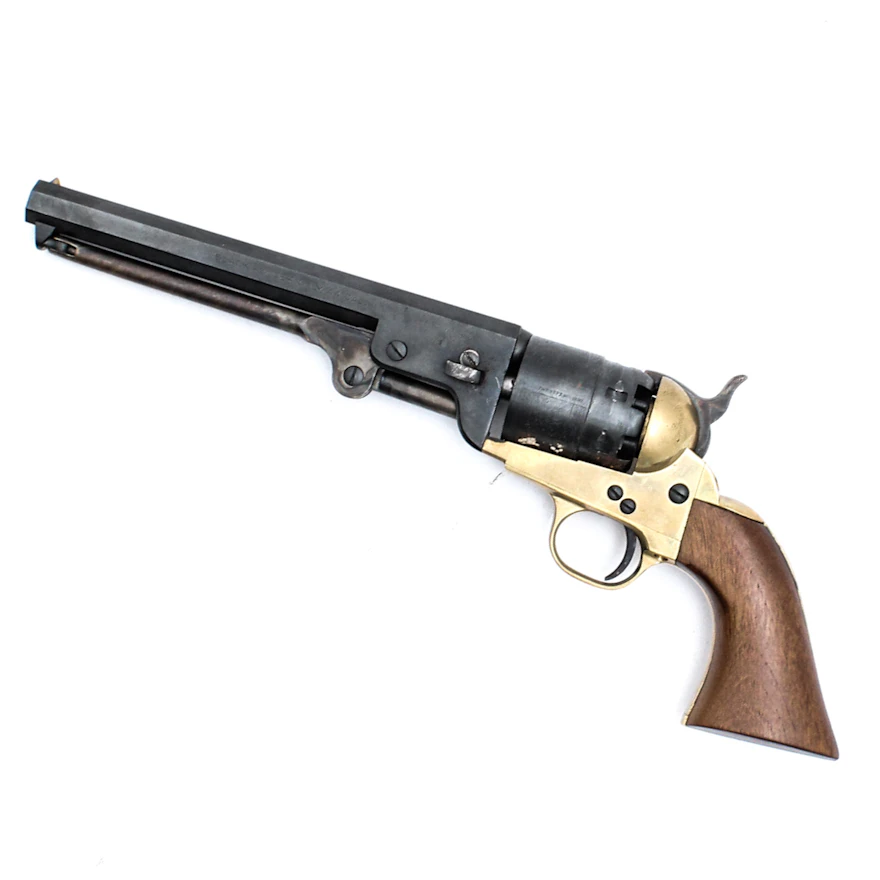
F.lli Pietta Firearms Serial Numbers
Key peopleProductsOwner, part of the holding companydivision inWebsiteA. Is an manufacturer of high quality replicas of 19th century, and as well as,. These replicas are commonly used by, participants in sports such as, working ranchers and target shooters who prefer traditional-style firearms. Thanks to their quality, Uberti replicas are also sought after by collectors and historical firearm enthusiasts.Uberti is located in, a suburb of, that has for centuries been the home to other firearm manufacturers and similar craft businesses. Independent for many years, Uberti was purchased and made into a subsidiary of Firearms and subsequently acquired byalso a member of the Beretta Holding Company.
Call us toll free: +1 888-744-0066. Home / Firearms / Revolvers / Pietta Single Action Revolvers. Pietta Single Action Revolvers Show Filters. Today, Pietta is a synonym for the most accurate and refined historical firearm reproductions, as well as high-quality guns for the most passionate hunting enthusiasts. As witness, this is the founder of the FAP Giuseppe Pietta, born in 1938. Solid man, able to tell with the.
Contents.Origins and history Aldo Uberti (d. 1998) founded his company in the foothills of the Italian Alps in 1959 to recreate long-obsolete but iconic firearms from the days of the American West and the U.S. The factory was (and still is) in in the province of, an area renowned for arms and armor manufacturing since the late Middle Ages. In particular, a manufacturing tradition of that area (dating back to the Renaissance) has been that of replicating foreign-style armor, most notably armor in the German style to be exported to and used in Germanic countries.
This was done in part to help establish the area as an important arms-manufacturing center, which it remains today, and in part to showcase the ability of local artisans and metalsmiths.Aldo Uberti had attended the Zanardelli gunsmithing school, and by age 14 he was already apprenticing with, a determining factor in his early career. He founded Uberti on the eve of the U.S. Civil War's 100th anniversary, when he was approached by U.S.
Businessmen who wanted to cater to the budding but promising reenactment market. Uberti's first replica was the 1851 Colt Navy revolver, followed by other civil-war-era models; later, he moved on to and designs. It was during this era that Colt ceased production of their famous or 'Peacemaker' revolvers.By the 1970s, Uberti had grown into an internationally recognized producer of Civil-War and Old West firearms, with high quality standards and a marked preference for forging their receivers out of solid steel rather than using casting or alloys. In the year 2000, Uberti was acquired by, thanks to whose substantial financing it upgraded the factory to a brand-new facility, thereby greatly expanding production capacity. By 2002, the factory was further modernized with CNC machinery; this enabled them to expedite certain manufacturing processes, although an amount of hand-fitting and hand-finishing remains necessary to this day for this type of firearm. Uberti in American western movies Uberti firearms have been featured in numerous Western movies thanks to their authentic looks. Italian filmmaker visited the Uberti factory in the 1960s to procure replica Civil War and Old West revolvers for use in all his Western films including.
Other movie credits include Uberti's featured in 's 1969, as well as the same model in 's (1979). All firearms in the 1990 Western starring were Ubertis, while a number of Uberti rifles and pistols have also been used in the 1993 film featuring. Current production Today, Uberti caters to collectors, civil war skirmishers as well as working ranchers, hunters and other outdoorsmen who need or prefer to carry traditional firearms into the field. Historically, Uberti has produced parts such as frames, cylinders, and barrels for several other manufacturers like, and, while current firearms made by the company are offered under both the Uberti brand names and those of importers Cimarron and Taylor's.Thanks to modern steels and the decades-old experience of the artisans assembling the guns, Uberti's replicas are highly regarded by shooters and collectors all over the world, sometimes thought as surpassing the originals in quality. It is for this reason that Uberti has been called 'The King of Replicas' by U.S.
Shooters and collectors. A Uberti-made Cimarron Model P in 32-20/32 WCF Business units and corporate ownership The Beretta Holding Company acquired Uberti with the explicit goal of dominating the market niche of replica firearms—a niche that up to that point Beretta had not entered. Through this acquisition, Beretta's intention was to quickly become the dominant force in this interesting market segment (particularly in the U.S.), by offering a product that reflected Beretta's own manufacturing standards.According to the then CEO of Beretta Holding, Dott. Piero Gussalli Beretta, 'the objective of this acquisition was that of leading the Beretta group onto the stage of America's most genuine tradition of cowboy-type firearms and shooting, through a brand that is comparable to Beretta in quality and prestige.' A year after the acquisition (2001), Uberti netted a record of $15M.
The current Uberti CEO is Dr. Giacomo Merlino.Today, the subdivision of Uberti is located in, within the U.S. Main offices.
Uberti is in fact part of the Benelli group, in turn a member of the holding family. (24 April 2005). (Kevin Michalowski ed.). Iola, Wisconsin: Gun Digest Books. Pp. 226–228. Lee, Jerry (12 August 2013).
Iola, Wisconsin: Krause Publications. P. 523. Stuart Phyrr, Heroic Armor of the Italian Renaissance, 321, 322. Farwest.it magazine, July 2001. ^ Hogg, Ian; Walter, John (29 August 2004).
David & Charles. Pp. 352–363. Wilson, Robert Lawrence (2008). Chartwell Books.
P. 175. True West Magazine, Scattergun Sidekick Unite, 24 May 2011. The Wall Street Journal, The Story of Guns in America, 9 February 2014. (2011). Iola, Wisconsin: Gun Digest Books. P. 128.
Magnum n° 2, year 3, p 68 – 73. Milano, Acquario Editrice, 1994. Joseph G. Bilby, Civil War Firearms: Their Historical Background and Tactical Use, Da Capo Press, 29 March 2005, 207. Colt 1873 Single Action, lupidicavatore.eu.
Beretta Acquires Uberti Shooting Industry Find Articles at BNET, findarticles.com. Tina Grant, International directory of company histories, St. James Press, 2001,. Carpenteri, Stephen D. (13 December 2013). Skyhorse Publishing Company, Incorporated. P. 341.External links.
| Remington New Model | |
|---|---|
Remington New Model Army Revolver made c. 1863 - 1875. | |
| Type | Revolver |
| Place of origin | United States |
| Service history | |
| Used by | United States Confederate States United Kingdom Australia Russian Empire Second Mexican Empire Mexico Empire of Japan France Native Americans |
| Wars | American Civil War American Indian Wars Franco-Prussian War |
| Production history | |
| Designer | Fordyce Beals |
| Designed | 1858 |
| Manufacturer | Remington Arms |
| Produced | 1862 to 1875 |
| No. built | Over 230,000 |
| Variants | 10 |
| Specifications | |
| Mass | 2 lb, 13 oz (1.27 kg) |
| Length | 13.25 in (337 mm) |
| Barrel length | 8 in (203 mm) |
| Cartridge | Powder & ball or Paper cartridge with conical bullet Metallic cartridge for conversion |
| Caliber | .31, .36, and .44 percussion, .32 rimfire (converted), .38 centerfire (converted), .38 rimfire (converted), .46 rimfire (converted) |
| Action | Single action |
| Muzzle velocity | 550–1286 ft/s |
| Effective firing range | sighted in at 75 yards |
| Feed system | 6 round cylinder (5 round pocket) |
| Sights | Fixed Post, Notched Top Strap |
The Remington-Beals Model Revolvers along with subsequent models and variations were percussionrevolvers manufactured by Eliphalet Remington & Sons in .31 (Pocket) .36 (Navy) or .44 (Army) caliber, used during the American Civil War, and was the beginning of a successful line of medium and large frame pistols. Microsoft remote desktop error code 0x204 mac catalina. They are commonly, though inaccurately, referred to as the Model 1858 due to the patent markings on its New Model barrels, 'PATENTED SEPT. 14, 1858/E. REMINGTON & SONS, ILION, NEW YORK, U.S.A./NEW MODEL.'; although wide scale production did not start until 1861.[1]
The Remington revolver was a secondary, supplemental issue firearm for the Union Army until the Colt factory fire of 1864. Due to the fire, the Colt 1860 Army was not available for some time. Subsequently, large numbers of the Remington revolver were ordered by the U.S. government. It was more expensive, by '50 cents' (a difference of more than US$12 in 2013 dollars), than the Colt, but those who could afford it remarked on its durability.[citation needed]
It saw use in the American West, both in its original percussion configuration and as a metallic cartridge conversion, as well as around the world.
Overview[edit]
The Remington is a single-action, six-shot, percussion revolver produced by E. Remington & Sons, Ilion, N.Y., based on the Fordyce Beals patent of September 14, 1858 (Patent 21,478).[2] The Remington Army revolver is large-framed revolver in .44 caliber with an 8-inch barrel length. The Remington Navy revolver is slightly smaller framed than the Army and in .36 caliber with a 7.375 inch [Beals Navy 7.5 inch] barrel length. There were three progressive models made: the Remington-Beals Army & Navy (1860–1862), the 1861 Army & Navy (1862–1863), and the New Model Army & Navy (1863–1875).[3] The three models are nearly identical in size and appearance. Subtle but noticeable differences in hammers, loading levers, and cylinders help identify each model. The 1861 Remington actually transitioned into New Model appearance by late 1862, slowly transforming throughout 1862, due to continual improvement suggestions from the U. S. Ordnance Department.[3][4]
Remington percussion revolvers are very accurate and capable of considerable power with muzzle velocities in the range of 550 to 1286+ feet-per-second, depending upon the charge loaded by the shooter. Combustible cartridge velocities averaged from 700 to 900 feet per second (270 m/s), depending on powder quality, charge and conical bullet weight. Combustibles were usually loaded with a special high performance sporting grade black powder, using the minimum charge required for a specified impact level, usually determined by pine penetration tests. The special powder and minimal charge reduced black powder fouling, allowing revolvers to be fired as much as possible before cleaning was necessary.[5][6]
Design[edit]
The Remington revolver owes its durability to the 'topstrap', solid-frame design. The design is stronger and less prone to frame stretching than the Colt revolvers of the same era. The internal lockwork of the Remington is somewhat simpler in construction. While the Colt employs separate screws for the cylinder stop and trigger, those components share the same through-frame screw in the Remington design.[7] Free sftp server windows 10. A downside in the design of the 1858 is that that the barrel and receiver are a single piece, making it more difficult to clean the barrel, as it cannot be removed.

Another innovative feature (first appearing in the 1863 Model production series) was 'safety slots' milled between chambers on the cylinder. The milled slot positively secured the hammer between chambers for safe carry by placing the hammer's firing pin where it did not rest on a percussion cap, eliminating the risk of an accidental discharge if the gun was dropped or the hammer struck. Most 19th-century revolver designs lacked such safety features. Early Whitney revolvers, for example, were similar to the Remington but lacked the safety slots. It was possible to lower the Whitney hammer between cylinder chambers for safe carry, but without the Remington milled slot, the Whitney cylinder could possibly slip and rotate, allowing the hammer to strike a loaded, capped chamber and cause an accidental discharge.
The Remington revolver permitted easy cylinder removal, allowing a quick reload with a spare pre-loaded cylinder; this being an advantage over other revolver designs of the time. It is, however, unlikely that this was common practice during the period. Spare cylinders were not provided by the Army.[citation needed]
Metallic cartridge conversions[edit]
In 1868, Remington began offering five-shot metallic cartridge conversions of the revolver in .46 rimfire. Remington paid a royalty fee to Smith & Wesson, owners of the Rollin White patent (#12,648, April 3, 1855) on bored-through revolver cylinders for metallic cartridge use. The Remington Army cartridge-conversions were the first large-caliber cartridge revolvers available, beating even Smith & Wesson's .44 American to market by nearly two years.
Due to the large volume of these pistols, individual gunsmiths also produced cartridge conversions (from cap and ball versions) in a variety of calibers such as .44-40 and .45 Colt.[1][8]
Buffalo Bill Cody pistol[edit]
William F. 'Buffalo Bill' Cody used an ivory-handled New Model Army .44, serial number 73,293, from 1863 until 1906, when he gave it to his ranch foreman with a handwritten note which said that, 'It never failed me.'[7]
In June 2012, the pistol came up for sale at auction and sold for a reported sum of US$239,000.[9] The Heritage Auctions company represented the pistol as 'The Most Important William F. 'Buffalo Bill' Cody Gun Extant'.[10] Accompanying the sale of the pistol were personal artifacts of Cody's including seventeen handwritten letters.[9]
Model series[edit]
The various pistols in this series with pertinent data.[11]
| Model | Frame | Years Mfg'd | Caliber(s) | Production | Barrel | Notes |
|---|---|---|---|---|---|---|
| Remington-Beals Army Model Revolver | Large | 1861-1862 | .44 | 1,900 (estimated) | 8 inch octagon | |
| Remington-Beals Navy Model Revolver | Medium | 1861-1862 | .36 | 14,500 (estimated) | 7 1/2 inch octagon | |
| 1861 Army Revolver (Old Model Army) | Large | 1862 | .44 | 6,000 (estimated) | 8 inch octagon | |
| 1861 Navy Revolver | Medium | 1862 | .36 | 7,000 (estimated) | 7 3/8 inch octagon | |
| New Model Army Revolver | Large | 1863-1875[12] | .44 | 132,000 (approximately) | 8 inch octagon | Used for factory conversions in .46 RF & .44 Remington |
| New Model Navy Revolver | Medium | 1863-1875 | .36 | 28,000 (approximately) | 7 3/8 inch octagon | Used for factory and U.S. Navy conversions to .38 RF & CF |
| New Model Single Action Belt Revolver | Large | 1863-1875 | .36 percussion and .38 CF | 2,500 - 3,000 (estimated) | 6 1/2 inch octagon | Factory conversion production started in 1873 |
| Remington-Rider Double Action New Model Belt Revolver | Large | 1863-1873 | .36 percussion and .38 CF | 3,000 - 5,000 (estimated) | 6 1/2 inch octagon | 1863-1865 available with fluted cylinder, conversions had two-piece cylinder |
| New Model Police Revolver | Medium | 1865-1873 | .36 percussion and .38 RF | 25,000 (estimated) | 3 1/2, 4 1/2, 5 1/2, 6 1/2 inch octagon | Conversions all believed to be rimfire only |
| New Model Pocket Revolver | Small | 1865-1873 | .31 percussion and .32 CF | 25,000 (estimated) | 3, 3 1/2, 4, 4 1/2, 5 1/2 | Majority produced as conversions or cartridge, 5 round cylinders only with a spur trigger |
Modern use[edit]
The Remington-Beals design lives on today in the form of replicas from Italian manufacturers Uberti, Pietta, and Euroarms; available in modern steel, and brass frame. The Euroarms and Uberti New Model Army replicas are nearly identical to the originals. These replicas are very popular in civil war reenacting and Cowboy Action Shooting. Several companies produce drop-in 'conversion' cylinders for replicas, enabling the firing of low-pressure modern cartridges without altering the revolver's frame. These conversions, of course, being akin to the original Remington cartridge conversions used on the Western frontier of the 1860s and 1870s. The percussion cylinder can be used interchangeably. Due to the value and delicacy of the original revolvers, they are not recommended for modern shooting purposes.[13]
See also[edit]
References[edit]
- ^ abBequette, Roy Marcot ; edited by James W.; Gangloff, Joel J. Hutchcroft; foreword by Arthur W. Wheaton; chapter introductions by Richard F. Dietz; book design by Robert L. (1998). Remington : 'America's oldest gunmaker'. Peoria, IL: Primedia. ISBN1-881657-00-0.
- ^Earle, Otis; Zimmerman, Dan. 'Gun Review: 1858 Remington'. www.thetruthaboutguns.com. Retrieved 10 October 2014.
- ^ abFlayderman, Norm (2001). 'V-E 'Remington Handguns''. Flayderman's Guide To Antique American Arms..And Their Values (8th ed.). Iola, Wisconsin: Krause Publications. pp. 137–142. ISBN9780873493130.
- ^'The Gun Report', Dr. Stephen Cook, February 1990[full citation needed]
- ^Thomas, Dean S. (2003). 'Federal Arsenals'. Round Ball to Rimfire: A History of Civil War Small Arms Ammunition, Part Three:. Thomas Pubns. pp. 1–10. ISBN978-1577470922.
- ^Cumpston, Mike; Bates, Johnny (2005). '23, 'Shooting the 1858 Remington Army and Navy Revolvers''. Percussion Pistols And Revolvers: History, Performance and Practical Use. iUniverse, Inc. pp. 132 et seq. ISBN978-0595357963.
- ^ abTaffin, John (2006). Gun digest book of the .44. Northfield, Ill.: Gun Digest Books. p. 17. ISBN978-0896894167. Retrieved 10 October 2014.
- ^Marcot, Roy ; edited by James W. Bequette; Gangloff, Joel J. Hutchcroft; foreword by Arthur W. Wheaton; chapter introductions by Richard F. Dietz; book design by Robert L. (1998). Remington : 'America's oldest gunmaker'. Peoria, IL: Primedia. ISBN1-881657-00-0.
- ^ abStaff. 'Lot 44094 The Most Important William F. 'Buffalo Bill' Cody Gun Extant. .. (Total: 11 Items) 2012 June 10 Legends of the Wild West Signature Auction - Dallas #6079'. historical.ha.com. Heritage Auctions. Retrieved 9 October 2014.
- ^Fraser, Paul. 'Buffalo Bill's Remington revolver achieves $239,000 at Heritage'. www.paulfrasercollectibles.com. Retrieved 9 October 2014.
- ^Flayderman, Norm (2001). Flayderman's guide to antique American firearms .. and their values (8th ed.). Iola, WI: Krause Publications. p. 146. ISBN0-87349-313-3.
- ^Remington Army and Navy Revolvers 1861-1888
- ^Butler, David F. (1971). United States Firearms: The first Century 1776-1875. Winchester Press. p. 208. ISBN9780876910306.